
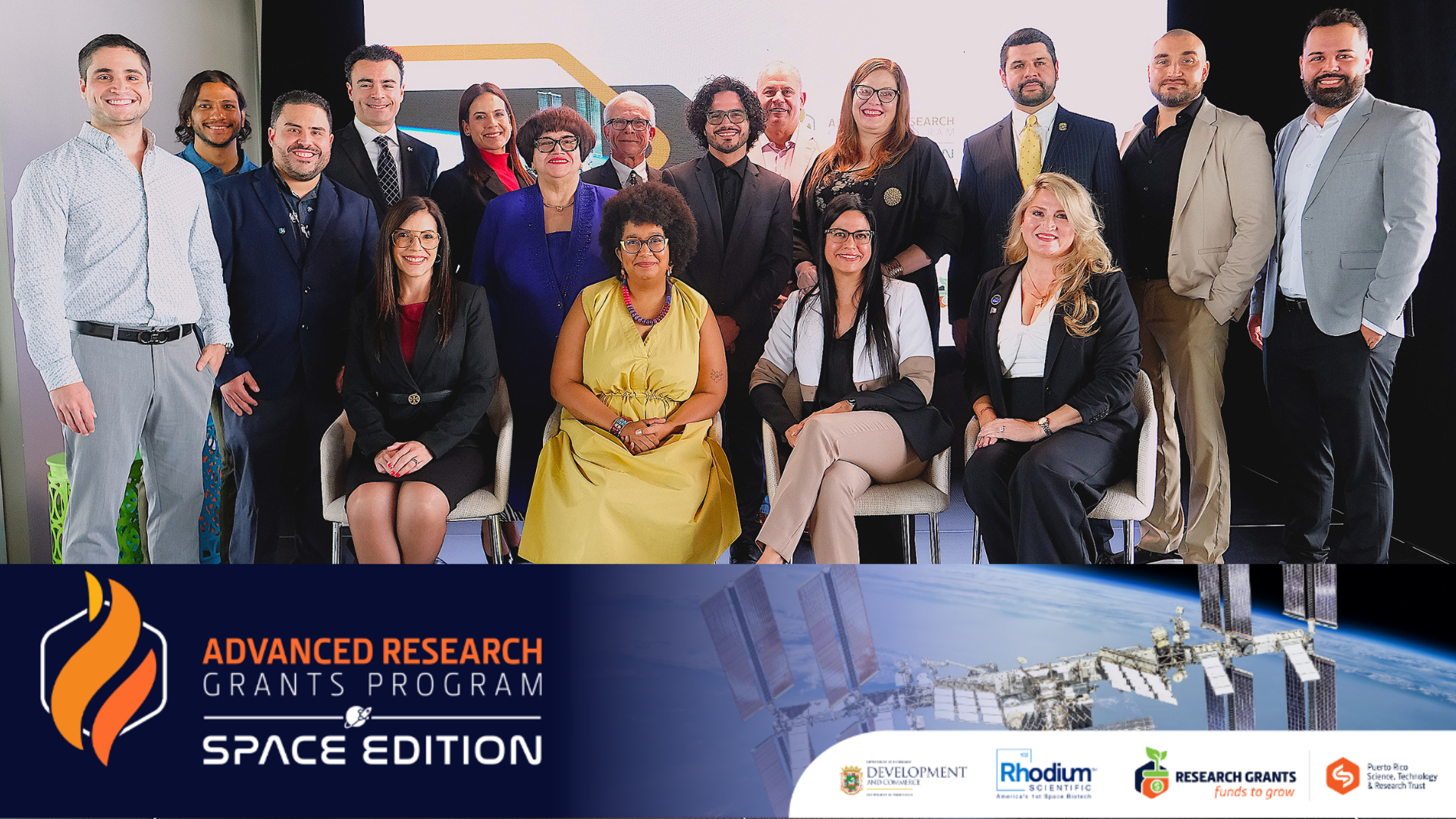
Through the Advanced Research Grant (ARG) Space Edition 2026, seven Puerto Rican research teams have been selected to conduct experiments aboard the International Space Station (ISS). Their projects span agriculture, biotechnology, aerospace, advanced materials, and biosensing, leveraging the unique environment of microgravity to explore scientific questions that cannot be fully answered on Earth. Meet the researchers behind these groundbreaking projects.
Growing Crystals in Microgravity

Torsten Stelzer, PhD | UPR Molecular Sciences Research Center (MSRC)
Project: Crystallization Experiments for Preliminary Data Towards an Automated Continuous Crystallizer for Advanced Materials Manufacturing in Space (ACCAMMS)
What is this project about?
This project will investigate how microgravity affects the way crystals form and grow. Researchers will conduct 72 crystallization experiments aboard the ISS using different compounds, temperatures, and concentrations and compare the results with experiments performed on Earth. The study will examine how microgravity influences crystal nucleation, growth, quality, and the incorporation of solvents during crystal formation.
Why it matters
Microgravity provides a unique environment where crystal growth occurs without many of the gravity-driven effects present on Earth. The knowledge generated through this project will help scientists better understand the processes that govern crystallization and support future research in space-based materials manufacturing.
Studying the First Plantain Plant in Space

Christopher A. Sambolín-Pérez, PhD | Inter American University of Puerto Rico, Barranquitas Campus
Project: Long-Term Physiological Adaptations of Plantains to Spaceflight Conditions: An In-Depth Analysis
What is this project about?
This project will study the first plantain plant sent to space and investigate how exposure to spaceflight conditions affects its biology. Using tissue-cultured plantains, researchers will analyze changes in gene activity, metabolism, microorganisms, physiology, and plant growth to better understand how this important crop responds and adapts to microgravity.
Because plantains are large plants with long growing cycles, they are not typically considered practical candidates for spaceflight experiments. Studying plant tissue cultures offers an innovative way to examine how this crop responds to the space environment at an early stage of development.
Why it matters
Plantains are among the world’s most important food crops and play a fundamental role in food security, particularly in tropical regions. By studying how plantains adapt to spaceflight conditions, researchers hope to identify biological and microbial traits associated with stress adaptation and crop resilience while advancing knowledge relevant to future food production systems in space.
Fighting Space Cavities with Caribbean Sargassum

Omar Vélez López, PhD |Ponce Health Sciences University
Project: Microgravity-Guided Development of Caribbean Sargassum-Derived Antibiofilm Bioactives Against Streptococcus mutans
What is this project about?
This project will evaluate compounds derived from Caribbean sargassum as potential antibiofilm agents against Streptococcus mutans, a bacterium associated with cavity-causing biofilms.
Experiments aboard the ISS will compare untreated and treated biofilms under microgravity conditions and on Earth, allowing researchers to study how spaceflight influences bacterial growth, acid production, surface attachment, and stress responses.
Why it matters
This project will improve understanding of how biofilms develop in microgravity and whether sargassum-derived compounds remain effective under spaceflight conditions. The findings could support the development of marine-derived oral care products while demonstrating how Caribbean sargassum, a Puerto Rican environmental challenge, can be transformed into a space biotechnology opportunity.
How Yeast Adapts to Spaceflight

Magda Latorre-Esteves, PhD | University of Puerto Rico at Mayagüez
Project: Microgravity-Induced Cellular Adaptation in Saccharomyces cerevisiae: Persistence, Mechanisms, and Biotechnological Relevance
What is this project about?
This study will investigate whether exposure to spaceflight induces biological adaptations in Saccharomyces cerevisiae, a species of yeast commonly used in scientific research and biotechnology.
Yeast samples flown aboard the ISS will be compared with ground controls after returning to Earth to determine whether any observed changes persist over time and to identify the molecular mechanisms associated with those adaptations.
Why it matters
Scientists still do not know whether some cellular adaptations to spaceflight persist after returning to Earth or are only temporary responses. This project will help answer that question while expanding our understanding of how living cells adapt to the unique conditions of space.
Advanced Materials for Spacecraft and Lunar Habitat Repair

Norman Burgos, PhD | Docare LLC
Project: Development and ISS Validation of NbB₂-Reinforced Aluminum Nanocomposite Fillers for Structural Repair in Spacecraft and Lunar Habitats
What is this project about?
This project will evaluate advanced aluminum welding fillers reinforced with niobium diboride nanoparticles under ISS mission conditions.
Researchers will expose different material formulations to a flight-relevant space environment and compare them with identical samples maintained on Earth. After the mission, the materials will undergo extensive testing to evaluate their mechanical and structural properties.
Why it matters
Future spacecraft and lunar habitats will require reliable structural repair technologies. This research will generate data on how these materials perform after exposure to space conditions and help reduce technical risk for future in-space repair and manufacturing systems. As agencies and companies work toward long-term lunar exploration, including NASA’s Artemis program, materials like these could help support the maintenance and repair of critical infrastructure in space and on the Moon.
Butterfly Development Beyond Earth

Riccardo Papa, PhD | University of Puerto Rico, Río Piedras Campus
Project: Development Beyond Earth: How Spaceflight Reshapes Genome Regulation, Chromatin Architecture, and Cell Fate
What is this project about?
Using butterfly wing development as a model system, this project will investigate how spaceflight affects genome regulation during development.
Researchers will analyze how microgravity influences gene expression, chromatin accessibility, three-dimensional genome organization, and interactions that help control developmental processes. Samples developed aboard the ISS will be compared with Earth-based reference data.
Why it matters
While previous research has examined how microgravity affects adult tissues and cells, much less is known about how spaceflight influences development itself. This project will generate foundational data on how changing physical environments affect genome regulation and developmental processes.
Smart Liquid Crystals for Space Biosensing

Claribel Acevedo-Vélez | University of Puerto Rico at Mayagüez
Project: Responsive Liquid Crystal Droplet-based Platforms for Microgravity-Enabled Biosensing and Advanced Materials Research
What is this project about?
Liquid crystals are best known for their use in everyday technologies such as smartphone and television displays, where they respond to stimuli by changing their optical properties. This project focuses on liquid crystal droplets that translate molecular and surface interactions into visible optical changes, making them useful for sensing applications.
Researchers will examine whether exposure to the spaceflight environment affects the stability, optical properties, and sensing capabilities of liquid crystal formulations developed to remain responsive over long periods of time.
Why it matters
Understanding how these materials perform after prolonged exposure to microgravity will help researchers develop guidelines for future biosensing technologies and responsive materials, both on Earth and in space.
Advancing Puerto Rico’s Role in Space Research
From agriculture and biotechnology to advanced materials and aerospace technologies, these seven projects showcase the diversity and innovation of Puerto Rico’s research community. By conducting experiments aboard the International Space Station, these researchers will generate knowledge that cannot be obtained under normal Earth gravity. Through the Advanced Research Grant Space Edition 2026, Puerto Rican scientists are advancing research in microgravity, while advancing research with potential applications in agriculture, biotechnology, biosensing, advanced materials, and biological adaptation, demonstrating how discoveries made in space can help address challenges both on Earth and beyond.